Source material and priorities
- Review existing publishing and customer questions
- Identify the audience and current priorities
- Agree the source material, measures and approval owner
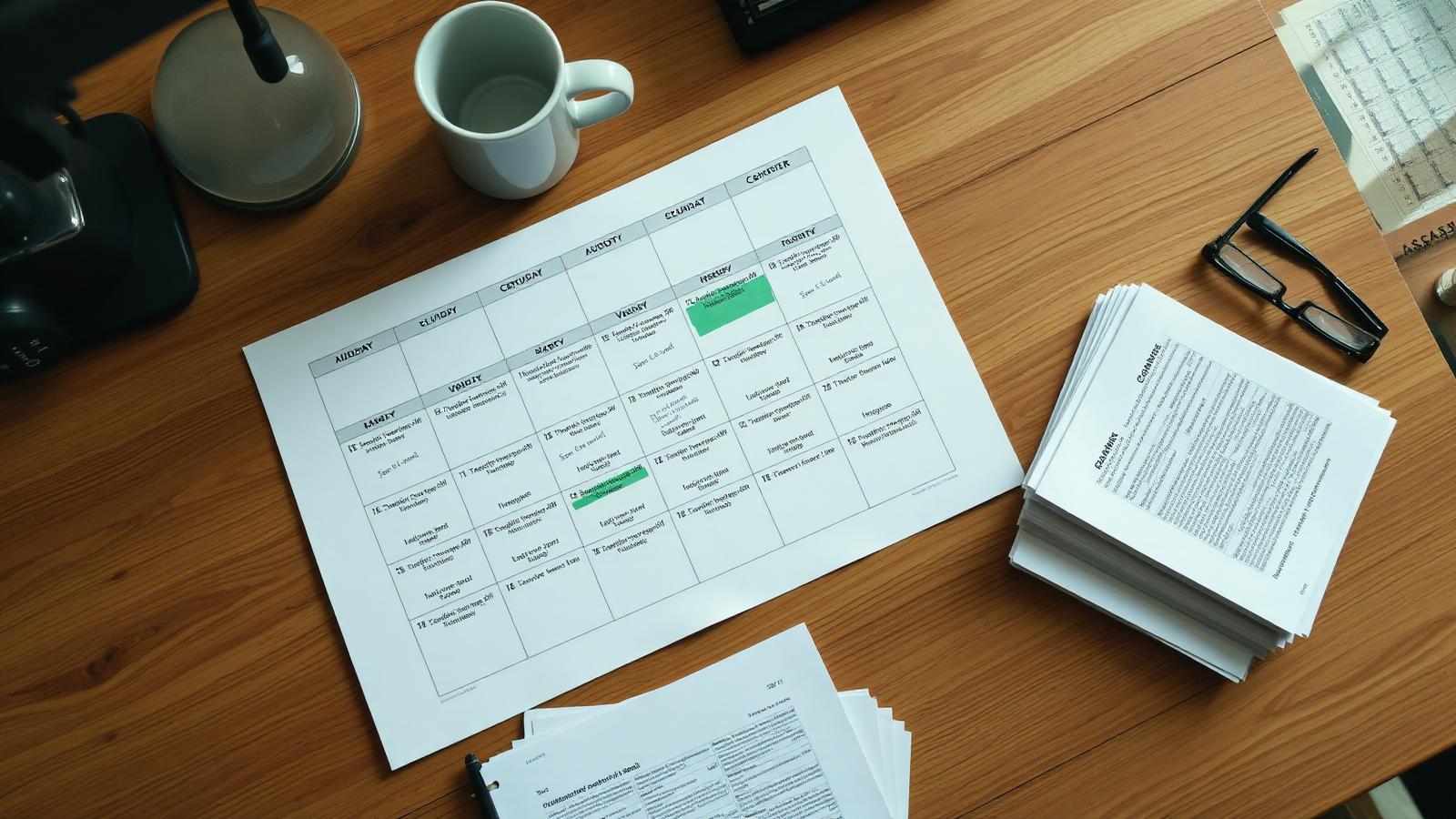
A calendar with a reason for each piece
We plan and write company posts around your expertise, customer questions and business priorities. Each post has a clear audience, supporting material and a purpose.
Thirty total posts, twenty written and designed deck slides, campaign planning and a weekly review in one monthly programme. Format is chosen for the idea, not a quota.
| Field | Planning question |
|---|---|
| Topic | What question should this piece answer? |
| Audience | Who needs the answer, and for which decision? |
| Source material | Which facts, interviews or documents support it? |
| Format | Which format gives the idea enough space? |
| Reviewer | Who checks the facts and approves publication? |
| Publish date | When is the piece relevant and ready? |
A topic still needs an angle, and a keyword still needs a position. Every entry has to answer four questions before it earns a place on the calendar.
Long-form gives you space to explain a position and the evidence behind it. Readers can use that detail to understand your argument and carry it into their next conversation.
That principle guides the company argument. Long-form articles are not an included monthly subscription unit.
This is the selection step of our method, applied to editorial. The weak answers are the ones most calendars are built on.
| The question | A real answer looks like | A weak answer looks like | What it proves |
|---|---|---|---|
| Why now? | A regulation changed on a known date and nobody has explained the operational consequence. | Competitors are posting about it. | A decision window has opened. |
| Why us? | We can share relevant company data, an expert account or checked research. | We have a point of view. | The claim can be owned rather than borrowed. |
| Who needs it? | The CFO and the board, who will ask the question in the next cycle. | Prospects at the top of the funnel. | The next room is identifiable by name. |
| What happens next? | Sales opens the follow-up with the finding, then sends the piece. | We add it to the resource hub. | The piece has a job after publication. |
Use these questions to prioritise topics. Selecting the work is what makes the calendar work: the pieces that remain get the attention that would otherwise have been spread across everything.
A cluster is one piece of thinking, published at three lengths. The angles come from the language buyers actually use.
A research-led article develops the central argument, with sources and a review schedule agreed in the brief.
Supporting articles explore questions that need more space and link to the central argument.
Shorter adaptations for the agreed channels, each written for its reader.
A review schedule keeps the central argument and its sources current.
The language buyers actually use, and the objection they raise before the third meeting, can provide a strong starting point for the calendar. The rest comes from events with dates and data only you hold.
A long-form structure and channel-specific adaptations show how one argument can travel. These formats are scoped separately from the monthly company post units.
A calendar tied to publishing slots produces volume. A calendar tied to authority gaps makes the case for each piece. This specimen shows the four selection questions, source material and a counterargument.
What question should this piece answer? Identify the audience, supporting material and next decision before choosing the format.
Why now? Why us? Who needs it? What happens next?
Start with the buyer’s question. Link to the relevant explanation, name the method and include the source material they need to review it.
End with the next step the reader needs to take.
Use text, static images, carousels or short edited videos as the work requires. Any of the 20 or 30 posts may be a video; the post count does not hide a format quota.
What question should this piece answer? Identify the audience, supporting material and next decision before choosing the format.
Why now? Why us? Who needs it? What happens next?
Evidence · audience · point of view
| Work | Purpose | Reader |
|---|---|---|
| Research articles | Develop an argument with sources and counterarguments | Readers evaluating the subject in depth |
| Sales material | Explain a decision, comparison or objection | Buyers and their internal reviewers |
| Reports | Organise research and findings into a reference | Teams who need the full evidence |
| Announcements | Explain a confirmed change and its context | Customers, employees, investors or press |
The deck allowance is twenty written and designed slides each month; any more would need a separately agreed scope.
The slides are a separate included deliverable, not another name for the 30 posts.
Where system access exists, organic pipeline share can be baselined and reviewed quarterly. Other dashboard measures are leading indicators, not guaranteed outcomes or an automatic inclusion in the monthly company post unit.
| What we read | Where it comes from | What it informs |
|---|---|---|
| Platform response | Available account analytics | Format and publishing decisions |
| Reader questions | Comments and relevant conversations | The next editorial brief |
| Owned-content activity | Analytics where access is agreed | Which explanations need more depth |
| Sales use and enquiries | CRM records and self-reported context | How the work supports a business conversation |
We agree the measures and data access at the start. Search, long-form and CRM measures need the relevant work and system access agreed in the brief.
| What we read | Source | Cadence |
|---|---|---|
| Read depth, scroll completion, time on flagship | Analytics | Monthly |
| Ranking on category head terms and questions | Search console, rank tracking | Monthly |
| Answer-engine citations and AI mentions | Test prompts, run with SEO Legendary | Monthly |
| Pieces cited in sales follow-ups and CRM notes | CRM | Monthly |
| Organic share of pipeline, against baseline | CRM attribution | Quarterly |
Start with source material, refine the work through approved drafts and use the first published pieces to inform the next plan.
Company Studio adds campaign planning and 20 written and designed deck slides to 30 total posts each month. The slide deliverable is distinct from the post count.
Gather leadership input, customer questions, existing material and any figures the company can substantiate. Define the claim and what would make it useful to a buyer.
Turn one position into a run of distinct posts. A direct statement, proof point, explanation and response to an objection can each do a different job.
Use the weekly review to check accuracy, voice and the next set of work. Nothing needs to publish before the client has approved it.
The source editorial practice selects topics from customer objections, sales questions, operating expertise and evidence. The calendar records the decision each piece is meant to help, not just a publishing date.
Which real buyer or category question does this piece answer?
Why is this point timely, and what can the company actually substantiate?
Who needs this explanation, and where will they see it?
Would text, static, carousel or an edited clip make the point clearest?
Which company owner checks the claim before it is released?
Company Social and Company Studio have distinct post counts. Each count is a monthly total across LinkedIn and X together; distribution between the channels is agreed in the editorial plan.
One company position carried through flexible post formats.
Company publishing, a designed deck and campaign planning.
| Deliverable | Company Social | Company Studio |
|---|---|---|
| Original company posts | 20 total per month across LinkedIn and X | 30 total per month across LinkedIn and X |
| Format | Text, static, carousel or edited video; no format quota | Text, static, carousel or edited video; no format quota |
| Video edit boundary | Up to 60 seconds from client footage; captions, cuts and branded graphics | Up to 60 seconds from client footage; captions, cuts and branded graphics |
| Written and designed deck slides | No included monthly slides | 20 per month, separate from posts |
| Campaign planning and review | Weekly review | Campaign planning and weekly review |
| Publication | Client approval first | Client approval first |
For company publishing: source material, a named reviewer and the weekly approval pass. A company owner checks facts and approvals; supply the footage if video edits are wanted. The weekly review is a working checkpoint, not a substitute for client approval.
High-volume technical SEO, website design, filming and paid distribution need their own scope. Company plans do include flexible post formats and video editing from client footage; Studio includes the stated fully designed deck slides.
Text, static images, carousels and video edits are available within that total. Any post may be a video; editing covers up to 60 seconds of footage supplied by the client, with captions, cuts and branded graphics.
Company Studio also includes 20 written and designed deck slides plus campaign planning. The slides are a separate included deliverable.
30 total posts across LinkedIn and X, 20 designed deck slides, campaign planning and weekly review
These four thought leadership plan prices are published in INR. The other currency rates shown elsewhere on Social apply to its existing catalogue.
Continue to a written brief Service selection and any optional extras carry into the brief. No charge is made here.No. Company Social includes 20 total posts and Company Studio 30 total posts across LinkedIn and X together. Distribution between the two channels is agreed in the editorial plan.
Bring them. Every proposed topic goes through the same four questions, yours included, and some fail at least two. That says nothing about the ideas themselves; the filter is what keeps attention on the pieces that remain. The calendar is reviewed with you on the weekly review and you approve every entry.
Material claims trace to evidence, context or named experience. A human editor checks sources and risk before work reaches you, and flags legal, confidential or reputational claims for your approval. Expert interviews are scheduled when the approved brief calls for them.
Yes. There is no video-format quota within the 20 or 30 total posts. Each edit is up to 60 seconds and uses footage supplied by the client. Captions, cuts and branded graphics are included.
No. Company Studio includes 20 written and designed deck slides in addition to its 30 posts.
The video scope here is editing client-supplied footage with captions, cuts and branded graphics. A filming commitment is not part of this published unit.
Both company plans include a weekly review. The client approves work before it is published.
A current standalone article is sold in one of three word bands up to 3,000 words. The long-form model is a longer category argument with sources, method and counterargument; it is a separate brief rather than an automatic inclusion in a company plan.
A separately commissioned editorial piece may use a search and answer-engine brief: queries, entities and sources worth citing. Rankings are not guaranteed. High-volume technical SEO belongs to a different scope, and any joint reporting is agreed in the brief.
A writer and editor are assigned to the approved brief. The team and any specialist research or design work are named before commitment; the current monthly company units define the counts and formats on this page.
Approved briefs, drafts and published pieces remain yours. The terms state 30 days’ written notice; cancellation, work in progress and handover follow the agreed terms.
The audit reviews your published work and other voices in your category, with screenshots, and identifies ideas you have evidence to support but have not yet published.